
Kim’s story at a glance
- 4 yearsin topical steroid withdrawal (TSW) before she tried a biologic.
- 1 yearsleeping in a recliner because the pain and swelling were so bad.
- 3-4 monthsafter starting with us, she was feeling really good.
The short version
- Kim had eczema as a child, then very little for decades. Steroid use in her 40s led to topical steroid withdrawal (TSW), and her whole body was affected.
- She spent about four years in TSW, tried traditional Chinese medicine and a biologic, and slept in a recliner for about a year.
- Working with our team at Eczema Conquerors, a detailed health history and a gut test showed what she hadn’t been able to find on her own.
- With a new protocol at each appointment, her skin improved step by step. She says her life is now “totally normal.”
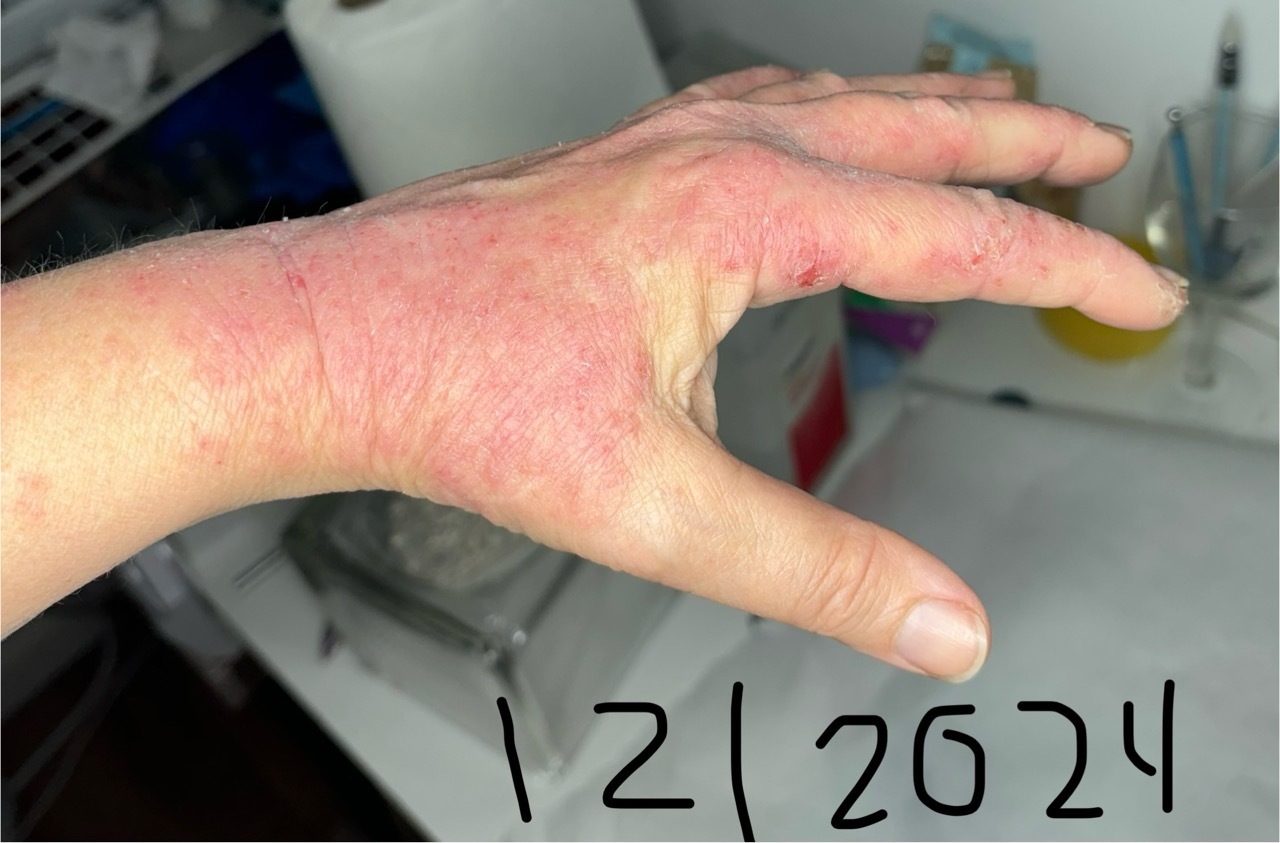
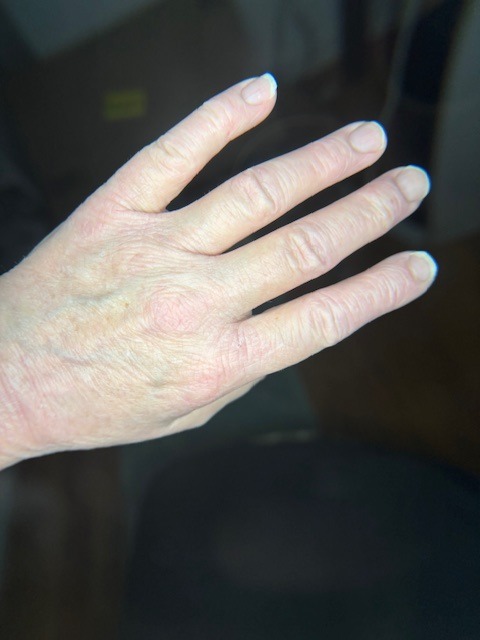
Kim’s hand, before and after. Shared with her permission. Results vary.
What it was like
Kim grew up with eczema, mostly in the creases of her arms, and it came and went. After high school it seemed to disappear, and from college until her 40s she had very little trouble. Then a rash appeared. Busy with work, she used a steroid every time it came back, until she realized she kept needing it and the rash was getting worse.
When she researched online, she realized she was in topical steroid withdrawal (TSW). Her eyes and lips swelled, her skin turned red and burning, and the redness spread from the creases of her arms to her neck, face and whole body.
- Cuts across her chest, and skin shedding everywhere. She vacuumed and shook out her blanket every day.
- Her legs swelled, so she slept in a recliner for about a year.
- Her face was shedding and her hands were wrapped, yet she still went into the office.
- Her social life shrank to a few close friends. She couldn’t put anything on her face because it burned.
What she tried before
Kim is independent and researched everything. Looking back, she wishes she had looked for more help sooner.
- Online TSW groups, where the advice was to wait it out. Six months in, a TSW specialist told her time would be the cure. She waited, and kept getting worse.
- About nine months of weekly drives into Manhattan for traditional Chinese medicine and acupuncture. “For me, it didn’t do much.”
- No moisture, moisture, baths, alkalizing and diet changes. “A million things you see online.”
- A biologic (Dupixent) at the four-year mark. It cleared her hands and much of her body, but made her face and eyes worse, so she stopped after seven or eight months.
- Pain medication from her doctor, just to get through the days.
Kim in her own words
Hear a short testimonial from Kim about her experience.
The turning point
Kim had known about Eczema Conquerors for years, but she was stuck on the idea that it was just a matter of time. After a stress-triggered flare about a year before this interview, she decided to stop waiting. “What am I waiting for?” she thought, and she reached out to our team at Eczema Conquerors.
She was nervous about working with a practitioner online, and found it “very seamless.” Looking back, she says contacting us was “probably the best thing I have ever done for myself.”
Three things stood out for her:
- 1A detailed health history. Our first visit is 80 to 90 minutes, so we can learn about your whole story.
- 2Testing. A gut test “told the whole story.” In her words, “nobody ever did a test like that on me.”
- 3A new protocol at every appointment. Each step helped her skin a little more, and she could ask questions in our weekly open-forum calls.
What we found and what we did
Kim had already cleaned up her lifestyle and products, so why was she still flaring? Her gut test and health history, which our team at Eczema Conquerors reviewed with her, pointed to several things working together:
- An imbalanced gutLeaky gut, certain bacteria running high, and H. pylori all showed up, which can keep the immune system overreactive.
- Fungal overgrowth and bacteria on the skinWe suspected fungal overgrowth, including Malassezia, which is linked to an itchy scalp and dandruff. Kim also believes bacteria on her skin was part of why she wasn’t healing.
- Nutrient deficienciesCertain nutrients were low, which can make it harder for skin to repair itself.
- Hormonal and neurotransmitter imbalancesOther markers showed hormonal changes and neurotransmitter imbalances.
- Nickel sensitivity, plus stressA sensitivity to nickel, and a lot of stress, made everything else worse.
Support, not judgment
Kim used a cream here and there, and she tried a biologic when she was at the end of her rope. “There’s no shame in that,” she says. “You have to do what you have to do until you figure out the root cause.”
We can work alongside your doctor and your medication, with no judgment, and we have supported many clients who were on medications while we did the deeper work.
Any change to medication should be made with your own doctor.
Where Kim is now
Kim says her skin has improved significantly. She says she can “do just about anything” now without her skin holding her back.
- No more itching, and no more hiding. “My life is totally normal.”
- No more hours in the bathroom washing, moisturizing and checking the mirror.
- No more rashes on her neck she couldn’t hide, even in 90-degree weather.
- Her skin started to clear gradually, and by about month three or four she felt really good.
Questions people ask
Can topical steroid withdrawal (TSW) improve?
Kim’s skin improved a great deal over a few months of working with her practitioner. Her story is one person’s experience. Everyone’s skin is different, so individual results and timelines vary and are not guaranteed.
Does it matter who you work with?
Kim’s advice is to find someone who is truly knowledgeable about eczema and TSW. It doesn’t have to be us, but a practitioner who sees these cases every day can spot patterns and read test results much faster.
What does working with Eczema Conquerors include?
Your own eczema-focused practitioner, private 1-on-1 sessions, a personalized plan and weekly support calls. See what’s included.
More client stories


Client stories are shared with permission and reflect individual experiences. Everyone’s skin is different and results vary. This is not medical advice. Please talk with your doctor about your own care.
Leave a Reply